
- DMG
- CHINA
- IN STOCK
- Banana Screen
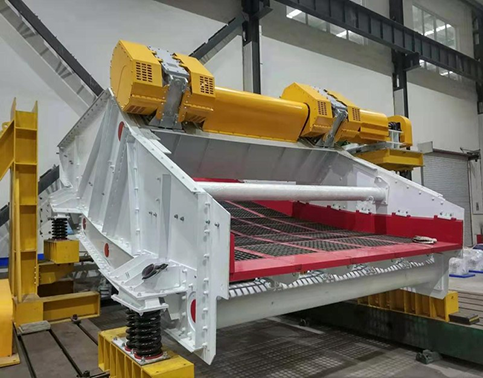
The Banana Screen is a self-synchronizing, heavy-duty, uniform-thickness screen with a banana-shaped screen box and a box-beam screen beam. The screen's drive system consists of an electric motor
Banana Screen
The Banana Screen is a self-synchronizing, heavy-duty, uniform-thickness screen with a banana-shaped screen box and a box-beam screen beam. The screen's drive system consists of an electric motor, which transmits power to the vibrating exciters via pulleys, a V-belt, and a universal joint shaft. The vibrating exciters are connected by an intermediate drive shaft. It is widely used for coal grading, desludging, dewatering, and de-mediuming, and is also used for screening large quantities of materials in mining operations. Compared to conventional screens of the same specifications, our company's Banana Screen boasts a higher throughput, 1.5 to 2 times that per unit area, making it a highly cost-effective vibrating screen.
I. Advantages of the Banana Screen
1. Simple and compact structure, high rigidity, high strength, balanced force distribution, and a high safety factor;
2. Reasonable vibration parameter settings avoid the natural frequencies of the screen body and reduce the effects of resonance;
3. The screen body has a service life of up to 10 years, and the vibrating screen exciter has a service life of more than 60,000 hours;
4. Lightweight, low power consumption, high vibration intensity (9-12mm), and high screening efficiency (> 95%);
5. Selected branded screen surface configuration, high screening efficiency and large material processing capacity;
6. Operating noise level is less than 75 decibels, ensuring stable operation;
7. The entire machine operates in S1 mode, ensuring 24-hour stable and continuous operation;
8. The Banana Screen uses an FF frequency analyzer for frequency response and dynamic analysis;
9. A comprehensive product range fully meets the screening process requirements of different material properties and processing volumes;
10. The Banana Screen is easy to operate and maintain, safe to use, cost-effective, with sufficient spare parts and timely and thoughtful service.
II. Working Principle of the Banana Screen
The banana screen is an improved vibrating screen. Its screen surface features a zigzag design with varying inclination angles, starting at 34° and then descending through a series of angles to a depth of approximately 10° at the discharge end. This zigzag screen design ensures a stable ratio of material flow rate to flow rate across the screen surface from the inlet to the outlet, ensuring a uniform material layer height.
The banana screen improves screening efficiency. When the material contains a high fine particle content, the banana screen can handle 1-2 times more material than a conventional vibrating screen of the same size. The banana screen's screening efficiency is particularly improved for high fine particle content, where the screened particle size is less than half the screen aperture.
III. Differences Between Banana Screens and Linear Screens
1. Structure
The banana screen's screen surface is curved, similar to the shape of a banana, with a radius typically ranging from 150-600mm. This curved screen surface adapts to changes in material flow across the screen surface, effectively guiding the material's flow. The screen surface has a smooth curved shape, without sharp angles, reducing the risk of material accumulation and blockage.
Linear screens: The screen surface is flat and generally consists of multiple rectangular or square screens, each with a fixed length and width. The screen surface relies on linear motion in both horizontal and vertical directions to move and screen the material. Compared to curved screens, linear screens increase the likelihood of material accumulation at corners.
2. Different Vibration Methods
Banana screens: A flexible support transmits bending vibration. When the support is subjected to force, it displaces, which is then transmitted to the entire curved screen surface, achieving composite vibration.
Linear screens: Typically, two perpendicular linear drive motors are used to generate simple superimposed horizontal and vertical vibrations. The combined vibrations in these two directions create composite motion on the screen surface through vector superposition.
3. Different Vibration Effects
Banana Screen: Arc-shaped vibration allows efficient material flow across the screen surface, reducing accumulation caused by stickiness. The arc also provides a certain degree of material guidance.
Linear Screen: Material flow relies on simple back-and-forth movement, which can easily lead to accumulation at corners. The lack of arc guidance results in relatively low cleaning efficiency when handling wet materials.
4. Different Screening Effects
Banana Screen: Due to its arc-shaped structure, it has self-cleaning capabilities when handling wet and viscous materials, preventing material from clogging the screen meshes over time. It is suitable for fine screening of viscous materials.
Linear Screen: While highly efficient for screening dry materials, it has a weaker cleaning ability when handling wet materials, prone to accumulation that affects screening accuracy. It is more suitable for coarse and fine grading.
5. Different Applications
Banana Screen: Primarily used for fine grading of highly wet and viscous materials such as coal, ore, and peat. Linear Screens: Suitable for coarse and fine classification of solid granular materials such as metal ores, stone, sand, and gravel, as well as particle size classification of industrial raw materials such as flour and chemical raw materials.
IV. What is the Amplitude of a Banana Screen?
The amplitude of a banana screen is typically determined by the specific design and application requirements. Therefore, different banana vibrating screens may have different amplitude ranges. The amplitude affects screening efficiency and processing capacity. Generally, a larger amplitude results in more vigorous particle movement on the screen surface, potentially leading to higher screening efficiency. However, material characteristics and processing capacity must also be considered. Excessively large amplitudes can cause material accumulation and premature particle passage through the screen apertures.
Small Banana Screens: The amplitude is 3-5mm. This type of screen is mostly used in laboratories or small-scale processing.
Medium Banana Screens: The amplitude is 5-8mm. This is a commonly used model in industry.
Large Banana Screens: The amplitude is 8-15mm. This is used for large-scale material processing.
The specific amplitude value varies depending on the banana screen model and batch size.
Therefore, when selecting a banana screener, the appropriate amplitude range should be determined based on factors such as the specific material properties, screening requirements, and processing capacity, combined with the manufacturer's technical specifications and recommendations. This can be achieved by communicating with the equipment manufacturer or engineer to ensure reasonable screening results and performance.




Product key description, this is a very good product description, detailing our product use, product characteristics