
- DMG
- CHINA
- IN STOCK
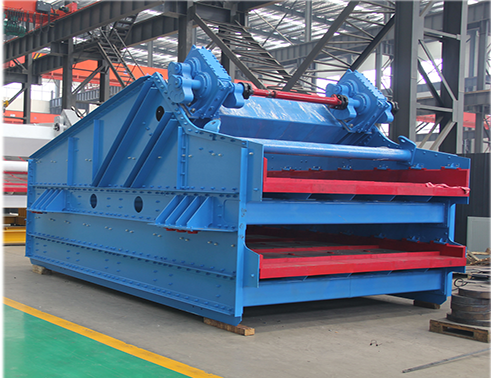
- Double-Deck Horizontal Vibrating Screen
Powered by the motor and the vibration force of the exciter, the main drive shaft drives the upper and lower screens to vibrate back and forth. The upper screen is used to screen coarser materials, quickly separating and discharging larger particles. The lower screen, on the other hand, is used to screen finer materials.
Double-Deck Horizontal Vibrating Screen
I. Working Principle of a Double-Deck Horizontal Vibrating Screen
Powered by the motor and the vibration force of the exciter, the main drive shaft drives the upper and lower screens to vibrate back and forth. The upper screen is used to screen coarser materials, quickly separating and discharging larger particles. The lower screen, on the other hand, is used to screen finer materials. The mesh size design allows finer materials to pass through while coarser materials remain on the screen. This allows the double-deck horizontal vibrating screen to simultaneously process materials of two different size ranges, achieving precise screening and grading, improving screening efficiency and production capacity.
2. Model specifications of double-deck horizontal vibrating screen
Model | specification(m) | weight(kg) |
HDS1548 | 1.5×4.8 | 8360 |
HDS1848 | 1.8×4.8 | 9817 |
HDS2448 | 2.4×4.8 | 11163 |
HDS2461 | 2.4×6.1 | 11853 |
HDS2473 | 2.4×7.3 | 19942 |
HDS3048 | 3.0×4.8 | 12069 |
HDS3052 | 3.0×5.2 | 22270 |
HDS3061 | 3.0×6.1 | 17063 |
HDS3073 | 3.0×7.3 | 22270 |
HDS3661 | 3.6×6.1 | 18751 |
HDS3673 | 3.6×7.3 | 30190 |
3. Which is More Efficient: A Single-Deck Horizontal Screen or a Double-Deck Horizontal Vibrating Screen?
In general, double-deck horizontal vibrating screens typically have higher screening efficiency than single-deck screens. This is because double-deck horizontal vibrating screens have an additional screening layer, allowing them to simultaneously screen two different particle size ranges, thereby improving screening efficiency and production capacity. Double-deck horizontal vibrating screens typically consist of two separate screening decks: an upper deck and a lower deck, each designed to screen materials of different particle size ranges. The upper deck is used for coarser materials, while the lower deck is used for finer materials. This double-deck structure can simultaneously process materials of two different particle size ranges, improving screening efficiency and throughput. Double-deck horizontal vibrating screens achieve higher screening efficiency and production capacity through optimal screening area allocation and vibrating force control. They can better meet the screening requirements of production lines for materials of varying particle sizes and can perform multiple screening processes on the same equipment, thereby improving production efficiency. However, it's important to note that screening efficiency depends not only on the structure of the screening equipment but also on a variety of factors, including material properties, mesh size, and vibration parameters. Therefore, when selecting a horizontal screen, it's important to comprehensively consider factors such as material properties, screening requirements, and equipment cost to determine an appropriate screening solution.
IV. Advantages of Double-Deck Horizontal Vibrating Screens
1. Improved Screening Efficiency: Double-deck horizontal vibrating screens utilize two independent screening surfaces, enabling simultaneous screening of two different particle size ranges, improving screening efficiency and processing capacity.
2. Multi-stage Screening and Grading: The double-deck structure enables multi-stage screening and grading, enabling precise separation and classification of materials according to varying particle size requirements.
3. Flexible Adaptability to Different Materials: Because double-deck horizontal vibrating screens can select the appropriate mesh size and vibration parameters for different materials, they offer excellent adaptability and can process a wide range of particle materials.
4. Space Saving: Compared to single-deck screens, double-deck horizontal vibrating screens occupy less space while maintaining the same screening capacity, effectively utilizing limited site resources. 5. Reduced clogging and adhesion: Double-deck horizontal vibrating screens are distributed across two levels, with finer materials screened on the lower screen surface. This reduces the possibility of clogging and adhesion, maintaining optimal screening results.
6. Improved product quality: Through multi-stage screening and grading, double-deck horizontal vibrating screens can more precisely control material particle size, improving product quality and consistency.
7. Reduced energy consumption: Compared to other screening equipment, double-deck horizontal vibrating screens have relatively low energy consumption, improving energy efficiency, helping to save energy and reduce production costs.




Product key description, this is a very good product description, detailing our product use, product characteristics