
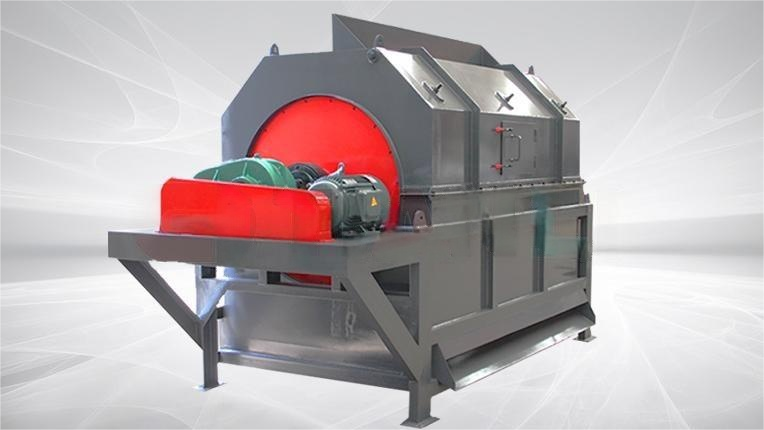
- DMG
- CHINA
- IN STOCK
- DRY MAGNETIC SEPARATOR
After the ore slurry flows through the feed box into the trough, the water flow from the feed water pipes disperses the ore particles into the feed area of the trough. Under the influence of the magnetic field, the magnetic particles aggregate to form "magnetic clusters" or "magnetic chains."
dry magnetic separator
Product Applications
● Can be used for pre-selection of low-grade ores, pre-enriching ore resources, improving mill grade, and reducing beneficiation costs;
● Can be used for tailings reselection, recovering relatively enriched tailings from the dry slope of the tailings dam;
● Can be used for magnetic separation and purification of sulfate slag powder;
● Can be used for iron removal of non-magnetic materials, with significant results and low beneficiation costs;
● Can be used for concentrate purification in magnetic separation plants, removing poorly bound particles and gangue from iron concentrate, improving concentrate grade, and increasing the technical added value of the plant's products.
Working Principle
After the ore slurry flows through the feed box into the trough, the water flow from the feed water pipes disperses the ore particles into the feed area of the trough. Under the influence of the magnetic field, the magnetic particles aggregate to form "magnetic clusters" or "magnetic chains." These "magnetic clusters" or "magnetic chains" are attracted to the magnetic poles by the magnetic force in the slurry, and are attracted to the cylinder. Because the polarity of the magnetic poles alternates along the direction of the cylinder's rotation and remains stationary during operation, the "magnetic clusters" or "magnetic chains" generate magnetic agitation as the cylinder rotates. Non-magnetic minerals such as gangue caught in these "magnetic clusters" or "magnetic chains" are dislodged during this tumbling process, ultimately attracting the "magnetic clusters" or "magnetic lotuses" on the cylinder's surface, representing the concentrate. The concentrate then follows the cylinder to the weakest magnetic point at the edge of the magnetic system, where it is discharged into the concentrate trough by flushing water from the unloading pipe. In the case of fully magnetic rollers, unloading is performed using brush rollers. Non-magnetic or weakly magnetic minerals remain in the slurry and are discharged from the trough as tailings.
Data
| Technical data | |||||||||
| Model | specification | rotation (r/min) | Magnetic induction intensity of cylinder surface(mT) | Capacity(t/h) | Size(mm) L×W×H | power (kw) | |||
| Drum diameter(mm) | Drum length(mm) | ||||||||
| CTL-0816 | Φ800 | 1600 | 0-63 | Determine magnetic induction intensity based on mineral properties | 35-55 | 3053×1295×1671 | 7.5 | 2750 | |
| CTL-0818 | Φ800 | 1800 | 55-70 | 3266×1295×1671 | 11.0 | 3300 | |||
| CTL-0821 | Φ800 | 2100 | 70-85 | 3936×1295×1671 | 15.0 | 3900 | |||
| CTL-0824 | Φ800 | 2400 | 85-100 | 4235×1295×1671 | 18.5 | 4450 | |||
| CTL-1021 | Φ1050 | 2100 | 0-50 | 100-130 | 4030×1545×2046 | 18.5 | 4800 | ||
| CTL-1021 | Φ1050 | 2100 | 100-130 | 4150×1545×1850 | 18.5 | 4680 | |||
| CTL-1224 | Φ1050 | 2400 | 115-150 | 4720×1545×1850 | 22.0 | 5180 | |||




Product key description, this is a very good product description, detailing our product use, product characteristics