
Antimony sulfide ore dressing equipment
Antimony sulfide ore beneficiation equipment: The commonly used methods for beneficiation of antimony sulfide ore are flotation and gravity separation. Alternatively, a combination of these two processes can be used: gravity separation for enrichment, followed by flotation for purification. Currently, this method is commonly used for low-grade antimony sulfide ore in China. Antimony sulfide ore with good ore properties and coarse embedded particles can also be directly subjected to gravity separation to obtain a qualified grade concentrate.
The beneficiation process of antimony sulfide ore beneficiation equipment is relatively simple. First, the vibrating feeder sends the large antimony ore into the jaw crusher for preliminary crushing; then a closed-circuit grinding process is adopted to evenly feed the material and water in a suitable proportion into the antimony ore ball mill for grinding. After grinding to a certain fineness, it is classified by the spiral classifier. The unqualified antimony ore powder needs to be sent back to the upper level for re-grinding; the antimony ore powder that meets the requirements is sent to the flotation machine for flotation and impurity removal. At this stage, the corresponding reagents need to be added for reasonable sorting, and then the concentrator is used for dehydration.
Flotation equipment for antimony sulfide ore beneficiation is the primary beneficiation equipment for obtaining powdered antimony concentrate. Almost all beneficiation processes include flotation equipment. The types of ores it can process include: single-antimony sulfide ores, mixed sulfide-oxidation antimony ores, tungsten-antimony-gold polymetallic sulfide ores, antimony-arsenic-gold sulfide ores, tin-lead-antimony-zinc polymetallic sulfide ores, antimony-lead-zinc-mercury polymetallic sulfide ores, and arsenic-antimony-gold polymetallic sulfide ores. The flotation process for single and complex antimony sulfide ores is illustrated using the beneficiation of single sulfide ore from the Shannan Mine of Xikuang and the tin, zinc, lead, and antimony polymetallic ore from Dachang, Guangxi as examples.
Working Principle of Antimony Sulfide Ore Beneficiation Equipment: Antimony sulfide ore is crushed and ground to separate various minerals into individual particles, with particle sizes meeting flotation process requirements. Various flotation agents are added to the milled slurry and agitated to react with the mineral particles, increasing the floatability differences between different mineral particles. The adjusted slurry is fed into the flotation cell and aerated. Mineral particles in the slurry come into contact and collide with the bubbles. The more buoyant particles selectively adhere to the bubbles and are carried upward, forming a mineralized foam layer composed of a gas-liquid-solid three-phase structure. These particles are mechanically scraped or overflow from the slurry surface, then dehydrated and dried to produce a concentrate. Mineral particles, such as gangue, that do not float are discharged from the bottom of the flotation cell along with the slurry as tailings.
There are many types of gravity separation equipment for antimony sulfide ore, but the most effective gravity separation equipment currently is the jig. Jigging for antimony ore separation offers advantages such as high recovery, high enrichment ratio, large processing capacity, low investment, and zero pollution, making it the ideal equipment for your success. Our factory has been engaged in the research and development and production of jigs for many years, continuously improving and updating them, overcoming issues such as the limited particle size range and high water consumption of jigs. Our jigs are significantly more efficient than similar domestic products. We offer a comprehensive range of equipment, including seven series and over ten models, with particle sizes ranging from 0 to 50 mm, meeting the diverse needs of our customers.
Flotation is the primary method for extracting antimony sulfide ore. Antimony sulfide ore is a readily floatable mineral, and flotation is often used to improve the ore's crystallinity. For stibnite, lead salts are often used as an activator, though copper salts or a combination of lead and copper salts are also sometimes used. Flotation is then performed using a collector, commonly using xanthate or a mixture of shale oil and ethyl thiocyanate. Foaming agents include pine oil or No. 2 oil. Antimony oxide ore is a difficult-to-float ore.
Flotation is the primary method for beneficiating antimony ore. For antimony sulfide ore, flotation is often used to improve the ore's grade. For stibnite, lead salts are often used as an activator, though copper salts or a combination of lead and copper salts are also sometimes used. Flotation is then performed using a collector, commonly using xanthate or a mixture of shale oil and ethyl thiocyanate. Foaming agents include pine oil or No. 2 oil. Antimony oxide ore is a difficult-to-float ore, and gravity separation is the primary method used.
The hardware configuration of an antimony sulfide ore flotation line requires the following antimony sulfide ore beneficiation equipment: jaw crusher, cone crusher, self-centering vibrating screen, ball mill, spiral classifier, hydrocyclone, flotation machine, thickener, filter, and auxiliary equipment such as electric vibrating feeder, belt conveyor, mixing tank, ore bin, sand pump, pump tank, motor, etc. The following is a systematic description of this equipment:
1. Jaw Crusher
Antimony sulfide ore beneficiation equipment: The jaw crusher is the front-end equipment of the antimony sulfide ore flotation line and is also one of the indispensable equipment types. Its function is to crush the material. Only after the initial crushing task can subsequent processing be carried out. The process requires it to have a sufficient production capacity to effectively ensure that the production line output meets the expected standards.
2. Cone Crusher
Antimony sulfide ore beneficiation equipment. A cone crusher is a highly automated crushing device. It also performs secondary crushing in flotation lines. Compared to traditional crushers, it offers a significantly higher crushing ratio, resulting in a more uniform particle size. After crushing, the material can be smoothly fed into the ball mill.
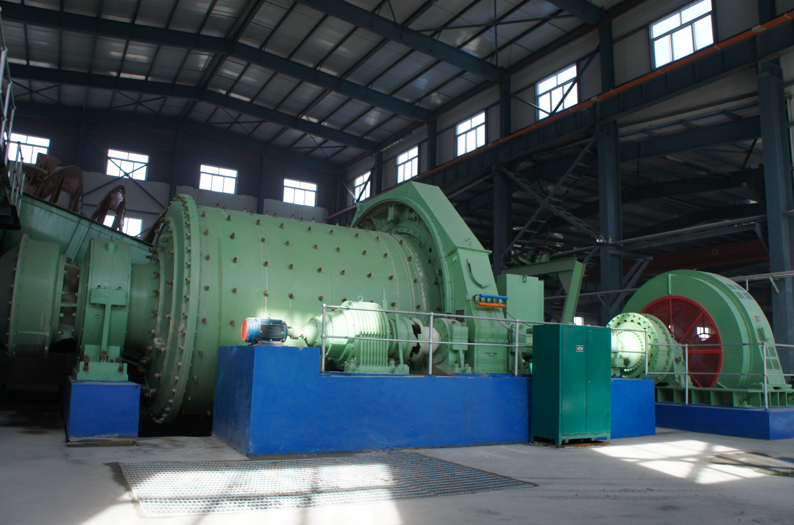
3. Ball Mill
Antimony sulfide ore beneficiation equipment. The ball mill's function in an antimony sulfide ore flotation line is to grind the material. It offers advantages such as excellent grinding performance and high precision. Only high-quality ball mill equipment can ensure excellent grinding precision. Therefore, during hardware configuration for the production line, reliability testing of the equipment's functionality and performance is crucial to ensure safety.
4. Flotation Cell
Antimony Sulfide Ore Beneficiation Equipment: The flotation cell is the core equipment of the antimony sulfide ore flotation production line. Its quality is directly related to the overall flotation performance. Red Star Machinery's flotation cells utilize the latest international manufacturing processes, resulting in exceptionally high flotation capacity and comprehensive performance. Only high-quality equipment can be perfectly matched to the production line, ensuring full utilization and meeting the customer's high standards.
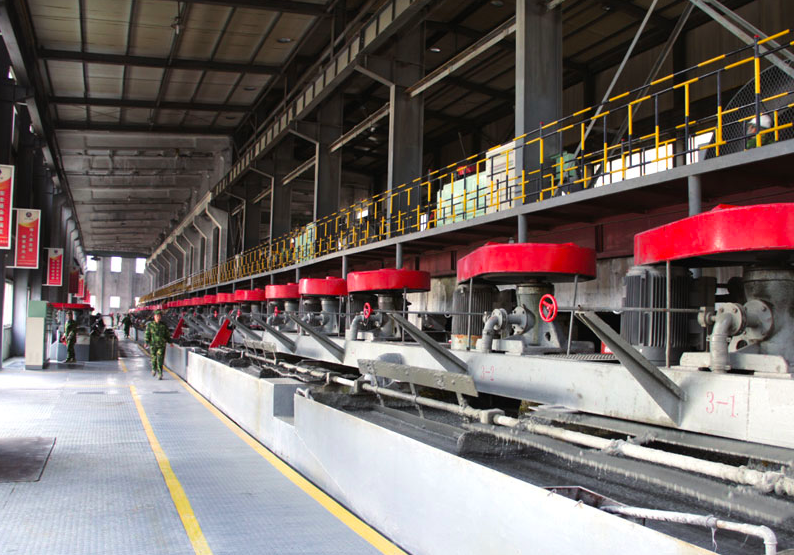
The selection of a flotation line for antimony sulfide ore beneficiation equipment depends on the ore properties and the required concentrate quality. Ore properties are particularly important, so when selecting a flotation process, attention should be paid to the particle size and coexistence of useful minerals in the ore; the ore's muddling during grinding; the mineral's floatability; the mineral composition and soluble salt content; the grade of the original ore; and the ore's degree of oxidation.
The gravity separation process for antimony sulfide ore beneficiation equipment is applicable to most antimony ore processing plants because antimony minerals are dense and coarse, making them easy to separate from the gangue by gravity separation. Among these, stibnite is an easy-to-separate ore; yellow antimonite, red antimonite, and antimonite are extremely easy-to-separate ores based on density. Only hydrous antimony calcium is difficult to separate based on density.
Gravity separation method of antimony sulfide ore dressing equipment: Gravity separation is applicable to most antimony ore dressing, because antimony minerals are minerals with high density and coarse particles, which are easy to separate from gangue by gravity separation. In short, whether it is a single antimony sulfide ore or a mixed antimony sulfide and oxide ore, it has good gravity separation conditions and low gravity separation costs. It can also separate a large amount of qualified coarse-grained concentrate within a coarse particle size range and discard a large amount of waste rock. Therefore, gravity separation is still a method that antimony ore beneficiators are happy to adopt. Antimony ore gravity separation equipment mainly refers to jigs, and sometimes shaking tables are also used.
The combined gravity and flotation process for antimony sulfide ore beneficiation equipment involves coarse and fine crushing of hand-selected ore to a particle size below 30mm. The ore is then screened and graded into three fractions: 8-30mm, 2-8mm, and 0-2mm. The resulting concentrates are then fed to an AM30 jig, an LTA1010/2 jig, and a sawtooth jig for gravity separation. The resulting concentrates are then mixed and fed into the gravity separation area. Following the gravity separation process, a flotation process is established, where the gravity separation tailings undergo grinding, grading, agitation, and flotation. The flotation process utilizes a one-coarse, three-fine, and two-sweep process. Flotation produces high-grade antimony flotation concentrate. The flotation tailings are then subjected to a shaker gravity separation process to recover fine-grained antimony oxide, resulting in high-grade antimony concentrate and tailings.
Application scope of antimony sulfide ore dressing equipment:
(1) Mainly single stibnite, with very little content of other all-metal minerals.
(2) All-metal stibnite ore, this ore contains arsenic and appears in the form of arsenopyrite, which is closely associated with all-metal. Generally, when antimony and arsenic are separated, antimony and all-metal are also separated.
(3) Oxygen-sulfur mixed ore, the ore does not contain arsenic, but contains relatively high secondary antimony oxide minerals. Currently, the only way to recover oxide ore is by gravity separation.
(4) Minerals containing tungsten and all-metal arsenic, but the all-metal content is high. Scheelite can also be recovered as a by-product.
(5) Minerals containing tin, lead, zinc, arsenic, etc., antimony appears in the form of brittle sulfide antimony lead ore, stibnite, tin-lead ore, etc.
(6) Antimony ore contains a large amount of lead, and cassiterite is also an important product of the dressing plant. Mercury-containing ore, the main minerals in the ore are stibnite and cinnabar, which have similar floatability.
Antimony sulfide ore beneficiation equipment performance advantages:
1. High degree of automation: The antimony sulfide ore beneficiation equipment utilizes an advanced electronic control system, which reduces the user's production management workload, improves the automation level of the entire production line, reduces production time and management costs, and increases production returns.
2. Water conservation: The flotation beneficiation process of the antimony sulfide ore beneficiation equipment recycles water resources, reduces water discharge during production, saves water costs, and reduces the impact of wastewater on the environment.
3. Rational layout: The entire antimony sulfide ore beneficiation equipment has a compact structure and a rational layout, effectively reducing production floor space and lowering the user's land investment costs.
4. High energy efficiency: The antimony sulfide ore beneficiation equipment we developed is highly efficient and energy-efficient. The flotation cell, the core equipment of the entire production line, can achieve energy savings of up to 60%, effectively increasing the user's production returns and reducing electricity consumption.
The internal structure of the beneficiation process for antimony sulfide ore beneficiation equipment, in addition to the basic process flow, also includes the grinding and grading times in each stage, the roughing, cleaning, and scavenging cycles, the methods for handling middlings, and whether the feed is branched or subjected to rate-selective flotation. In each separation cycle, the first separation operation in which the feed enters is called roughing. Roughing is typically performed only once and primarily serves to flotate medium-sized, easily floatable individual particles. (Occasionally, a secondary roughing operation may also occur. This occurs because the roughing ore has different floatability and some must be roughed under different conditions, while the secondary roughing concentrate can be combined with the primary roughing concentrate.) The process used to process the roughing froth product to improve the concentrate grade is called cleaning. The roughing tailings typically contain difficult-to-float coarse and fine particles, or incompletely separated contigs. Scavenging is the process used to process the roughing tailings to improve recovery. If the roughing tailings contain a high concentration of unseparated contigs and still have a high grade, they can be sent for regrinding and re-cleaning.



