
Fine-grained disseminated gold ore
my country possesses abundant and widely distributed disseminated gold resources of fine-grained type, but the beneficiation of this type of gold ore is quite challenging. Therefore, extracting high-grade gold concentrate from fine-grained disseminated gold ore is an important research topic. This article takes a fine-grained disseminated gold ore as an example to introduce the beneficiation process of fine-grained disseminated gold ore.
The characteristics of fine-grained disseminated gold ore: The minerals are mainly pyrite, colloidal pyrite, marcasite, and arsenopyrite, followed by pyrrhotite, colloidal marcasite, limonite, hematite, chalcopyrite, sphalerite, galena, rutile, etc., and small or trace amounts of covellite, tetrahedrite, magnetite, ilmenite, smithsonite, cerussite, stibnite, native gold, and argentite. The gangue minerals are mainly quartz, with small amounts of feldspar, calcite, dolomite, chlorite, sericite, etc., and trace minerals such as kaolinite, jarosite, graphite, apatite, and zircon. Gold occurs in the form of native gold, mainly in the form of fine grains (grain size mostly less than 0.037 mm), primarily as encapsulated gold (encapsulated in pyrite, arsenopyrite, and gangue minerals), followed by intergranular gold and fractured gold.
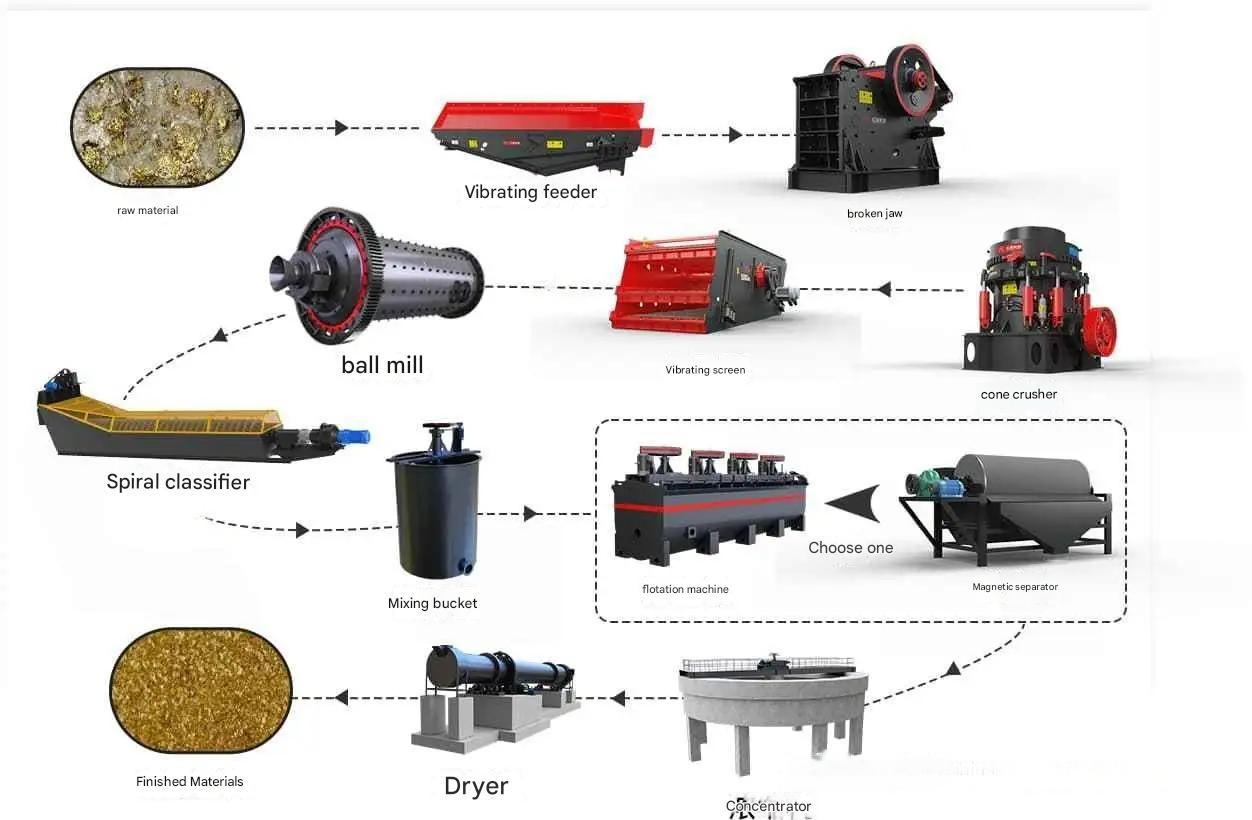
Fine-grained gold refers to gold in gold ore that is encapsulated within the ore minerals in the form of tiny particles. These particles are typically very small, usually less than 20 micrometers in diameter. Because these particles are so small, they are difficult to extract using traditional gold extraction methods, thus requiring specialized processes. The following describes a common beneficiation process for fine-grained disseminated gold ore.
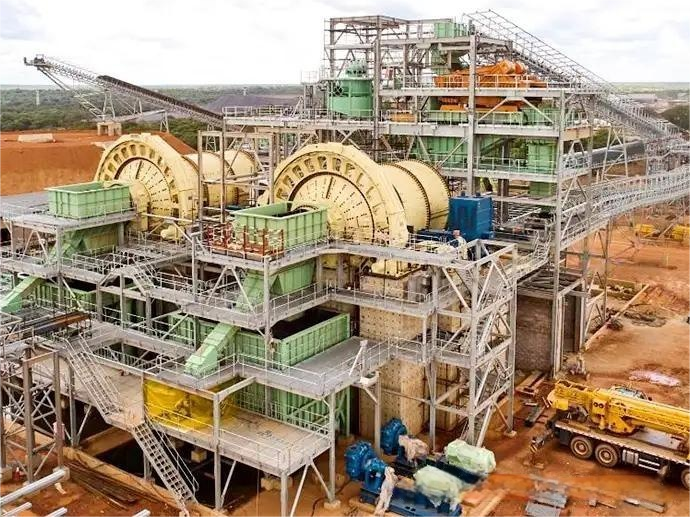
The beneficiation process for fine-grained disseminated gold ore mainly includes the following steps: Ore crushing and grinding: First, the raw ore needs to be crushed to a suitable particle size using equipment such as jaw crushers and cone crushers. Then, it is fed into a ball mill or rod mill for further grinding to a suitable flotation particle size (usually below 0.074 mm). Slurry preparation and reagent addition: The finely ground ore is mixed with water to form a slurry, and the slurry concentration is adjusted (usually 25%-35%). During slurry preparation, collectors (such as xanthates and diammonium phosphates) are added to enhance the hydrophobicity of gold minerals, frothers (such as pine oil and alcohols) help generate stable froth, and modifiers (such as lime and sodium carbonate) are added to adjust the pH value of the slurry and optimize flotation conditions. Flotation separation: The prepared slurry is fed into a flotation machine. Through stirring and aeration, the hydrophobic gold minerals adhere to the bubbles, forming a froth layer, which is then scraped off to obtain gold concentrate. Hydrophilic gangue minerals remain in the slurry and are discharged as tailings. Concentrate treatment: The gold concentrate obtained from flotation is dewatered (concentrated, filtered) and dried to obtain the final product. Tailings treatment: Tailings are reprocessed or discharged to ensure environmental protection. Wastewater treatment: Wastewater generated during the flotation process is treated, recycled, or discharged in compliance with standards.
Customized beneficiation process for fine-grained disseminated gold ore: After microscopic identification of the ore properties and analysis of beneficiation experiments, a grinding-pre-decarbonization-flotation process was determined. Based on the ore property analysis, the following technical measures were implemented: ① Increasing the grinding fineness to improve the liberation degree of gold minerals and gold-bearing minerals. ② Pre-decarbonization to reduce carbon interference in gold flotation and improve gold concentrate grade and recovery rate. ③ Adding an appropriate amount of water glass to disperse slime and increase the flotation velocity of gold minerals and gold-bearing minerals. A final grinding-pre-decarbonization-flotation process was designed for this ore.
The beneficiation process for fine-grained disseminated gold ore is as follows: Grinding process: To maximize the liberation of gold minerals and gold-bearing minerals, a two-stage grinding process was adopted after grinding experiments, with a grinding fineness of -0.038 mm and a mass fraction of 80%. Pre-decarbonization process: The minerals obtained after grinding underwent flotation decarbonization pretreatment using quantitative water glass and No. 2 oil, resulting in a good gold rough concentrate grade. Flotation process: This stage adopted a process of roughing, scavenging, re-grinding of the rough concentrate, and secondary cleaning. NC was used as a modifier to adjust the pulp pH, copper sulfate as an activator, water glass as a dispersant, and butyl xanthate and butyl ammonium black reagent as collectors for flotation. The final gold concentrate yielded a gold content of 41.76 g/t and a gold recovery rate of 89.21%, achieving good gold recovery from the ore.
The above is an introduction to the beneficiation process of a fine-grained disseminated gold ore. In actual beneficiation plants, the properties of gold ore vary regardless of the type. To obtain an ideal gold concentrate grade, it is recommended to conduct beneficiation tests and analyses, and then design a suitable gold extraction process.



