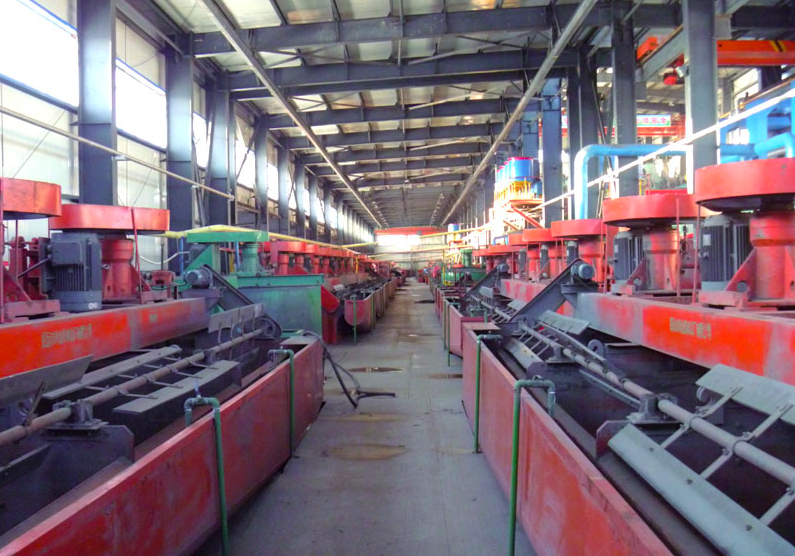
Copper concentrate flotation machine
Copper concentrate flotation machine | Copper ore powder flotation machine makes full use of the dissociation characteristics and floatability differences between copper minerals during the flotation process, and gives priority to timely floating or monomer dissociation of minerals and collects them early, which can avoid over-grinding of some minerals or surface contamination, thereby improving the mineral separation effect and improving the copper ore beneficiation indicators.
The copper concentrate flotation machine | copper ore flotation machine mainly consists of a slurry tank, a stirring device, an aeration device, a mineralized bubble discharge device, an electric motor, etc.
(1) Copper concentrate flotation machine | copper ore flotation machine slurry tank: It has a slurry inlet and a gate device for adjusting the slurry surface. It mainly consists of a tank body welded with steel plates and a gate welded with steel plates and round steel.
(2) Copper concentrate flotation machine | copper ore flotation machine stirring device: It is used to stir the slurry and prevent the ore sand from settling in the tank body. It mainly consists of a pulley, an impeller, a vertical shaft, etc. The impeller is made of wear-resistant rubber.
(3) Copper concentrate flotation machine | Copper ore flotation machine aeration device: It consists of a duct inlet pipe. When the impeller rotates, negative pressure is generated in the impeller cavity, and air is sucked in through the hollow pump pipe and dispersed in the slurry to form a bubble group. This slurry with a large number of bubbles is quickly thrown to the stator by the rotational force of the impeller, further refining the bubbles in the slurry and eliminating the rotational motion of the slurry flow in the flotation tank, resulting in a large number of vertically rising microbubbles, providing the necessary conditions for the flotation process. (4) Copper concentrate flotation machine | Copper ore flotation machine mineralization bubble removal device: It scrapes out the foam floating on the tank surface. It is mainly composed of a motor driving a reducer, and the reducer driving a scraper.
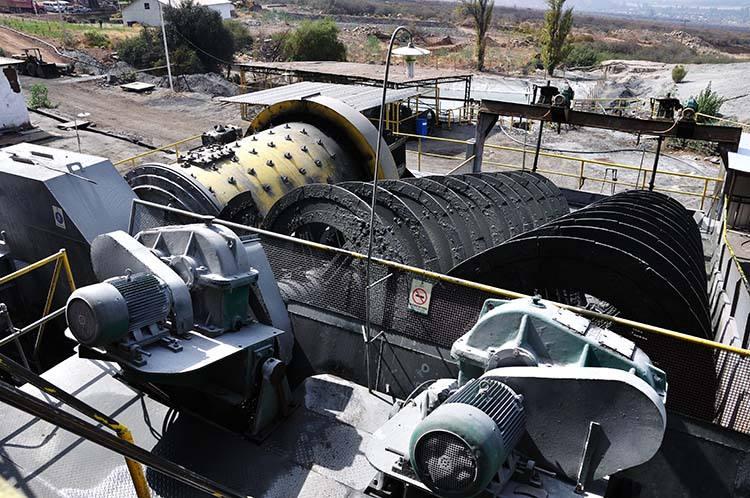
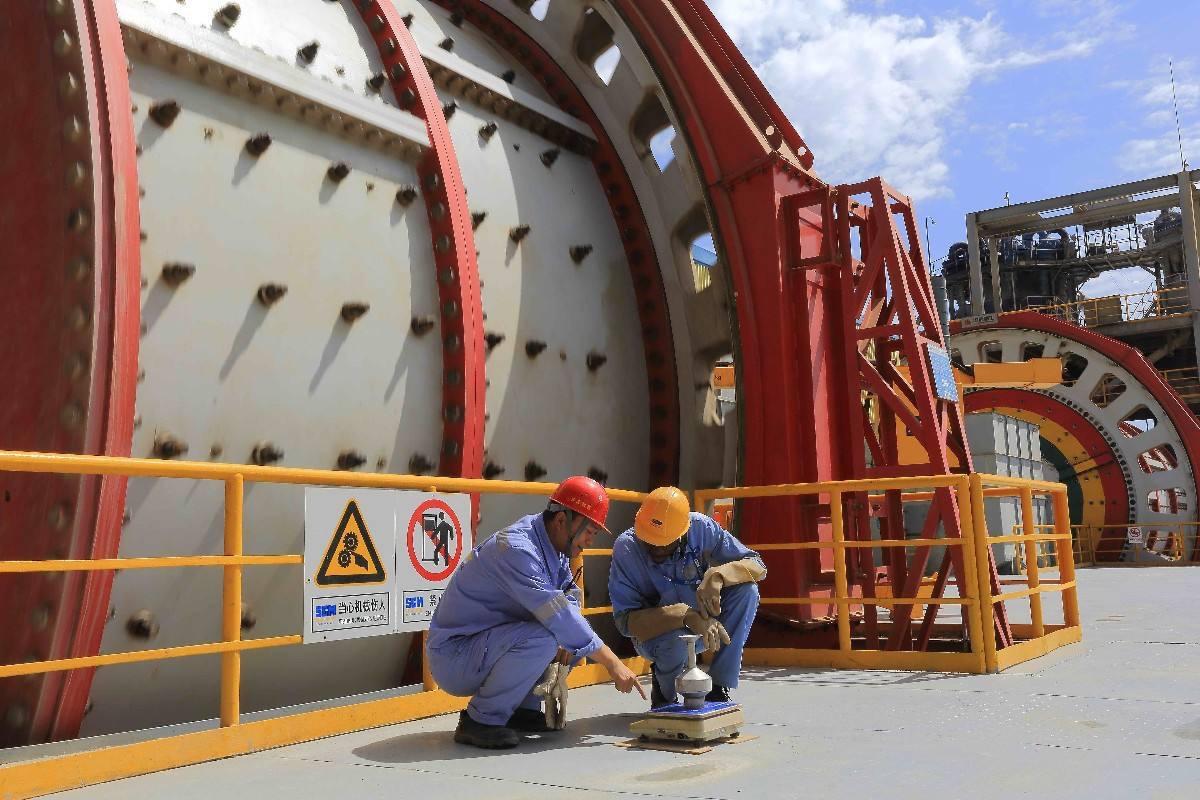
Copper concentrate flotation machine | Copper ore powder flotation machine Flotation process: Due to the characteristics of copper ore, jaw crushers are generally used for coarse crushing. Jaw crushers can crush copper ore to 10-400mm. The discharge opening adjustment range varies depending on the model. Due to the wide variety of jaw crusher models, they can comprehensively perform coarse, medium, and fine crushing on copper ore. Copper ore mined from the mountains is first fed evenly and continuously into the jaw crusher feed opening via a vibrating feeder. Feeding must be within the jaw crusher's feed range, and ore with too large a particle size or other hard objects cannot be fed in. Cone crushers are generally used for fine crushing of copper ore. The discharge particle size of cone crushers is between 12-60mm. Compared with the discharge particle size of jaw crushers, cone crushers are more suitable for fine crushing of copper ore. Cone crushers are divided into standard, short head, and medium head types. Select the appropriate one based on the discharge requirements. The finished product from the jaw crusher is screened on a circular vibrating screen, and the qualified particle size is then fed into a cone crusher for crushing. For grinding, a copper ball mill is used. Developed specifically for the grinding characteristics of copper ore, these mills come in 34 sizes with a production capacity ranging from 0.65 to 615 tons/hour. This mill primarily performs secondary pulverization of the copper ore, using the impact of steel balls to grind the ore into small, round particles for subsequent flotation processing. After crushing in the cone crusher, the ore is screened on a circular vibrating screen to select the particle size that meets the feed requirements of the copper ball mill. The ore then enters the copper ball mill for grinding. After grinding, the copper ore is classified using a spiral classifier. In actual production, the spiral classifier is directly connected to the ball mill, and the finished product from the ball mill is directly fed into a classifier for classification. The spiral classifier utilizes the different settling rates of objects with different gravities to separate weeds, mud, and decaying matter from the copper ore, thereby improving the purity of the copper ore. Flotation is an important part of copper ore beneficiation process. It mainly uses copper concentrate flotation machine | copper ore powder flotation machine. The flotation machine uses the method of reagent flotation. Through continuous stirring, it refines the foam at the same time, so that the minerals adhere to the foam and float to the surface of the ore pulp to form mineralized foam. The foam is scraped off with a scraper to obtain copper concentrate. The processing capacity of the flotation machine is 0.18-20m³/min. The finished copper ore processed by the flotation machine has a high grade.
Copper concentrate flotation machine | Copper ore flotation machine flotation process types include: preferential flotation, mixed flotation, equal floatability, partial preferential-mixed flotation, rapid flotation, step-by-step preferential flotation, partial mixed flotation, and asynchronous mixed flotation.
Copper concentrate flotation machine | Copper ore flotation machine operating principle: As the impeller rotates, the slurry in the tank is drawn from all sides through the bottom of the tank and into the space between the impeller blades. Simultaneously, low-pressure air supplied by the blower enters through the hollow shaft and the impeller's air distributor. After thorough mixing between the blades, the copper ore and air are pushed upward and obliquely from the periphery of the upper half of the impeller. After being stabilized and directed by the stator, the air enters the entire tank. The bubbles rise to the foam stability zone. After enrichment, the foam flows out of the overflow weir by gravity into the foam tank. A portion of the slurry flows to the bottom of the impeller, where it is agitated and remixed to form mineralized bubbles. The remaining slurry flows to the next tank, ultimately becoming tailings.
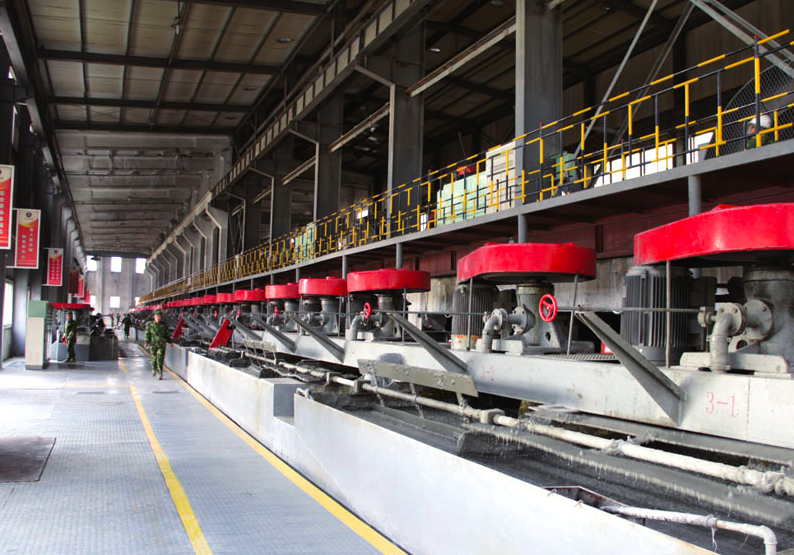
The types of copper concentrate flotation machines | copper ore powder flotation machines mainly include XCF flotation machines, KYF flotation machines, XJQ self-priming mechanical agitation flotation machines and BF flotation machines. Among them, XCF flotation machines and KYF flotation machines can be combined into a combined unit according to different needs based on their own mechanical characteristics. XCF and KYF models can be configured together, with XCF as the suction trough and KYF as the direct current trough. The return of the middling ore eliminates the need for a foam pump. Copper concentrate flotation machines | copper ore powder flotation machines can be divided into four categories according to their different aeration and agitation methods:
I. Mechanical agitation flotation machines It is further divided into agitation self-priming flotation machines and aeration-agitation flotation machines. (1) Agitation self-priming flotation machines
A flotation machine that stirs the ore pulp with a rotating impeller, uses the locally formed negative pressure zone to inhale air from the atmosphere outside the tank, and generates bubbles by turbulent crushing.
(2) Aeration-agitation flotation machine A flotation machine that generates dispersed bubbles by agitating the slurry with low-pressure aeration and rotating impellers.
2. Aeration flotation machine and flotation column A flotation machine in which air is dispersed into bubbles in the slurry through a nozzle or porous medium under a certain pressure.
3. Induced aeration flotation machine A flotation machine that uses a high-speed jet of slurry to induce or entrain air, and then releases it from the slurry in the form of reduced pressure to generate microbubbles.
4. Air precipitation flotation machine A flotation machine that uses the principle of reduced pressure release to cause air to precipitate from the slurry onto the surface of hydrophobic mineral particles, thereby achieving bubble mineralization.
Copper concentrate flotation machines | Copper ore flotation machines offer the following advantages:
1. Compact and well-designed accessories
Copper concentrate flotation machines | Copper ore flotation machines typically integrate aeration and agitation components, including the impeller, cover plate, main shaft, air inlet pipe, and air cylinder, into a single unit. This allows the impeller and cover plate to be concentrically assembled, ensuring the required clearance between the impeller and the cover plate guide vanes, and facilitating easy maintenance and replacement.
2. High flotation accuracy
The copper concentrate flotation machine | Copper ore flotation machine utilizes a multi-stage separation cell design, allowing the entire flotation process to be completed step-by-step. This creates a cascade optimization process, adapting to the varying properties of the material at different locations and improving separation accuracy.
3. Stable product specifications and low cost
The copper concentrate flotation machine | Copper ore flotation machine ensures excellent and stable performance for difficult-to-separate and complex copper ores, or when high-grade concentrate is desired. Furthermore, during the flotation process, its components exhibit minimal wear, energy consumption is low, and investment costs are minimal.
Flotation, like other mineral processing methods, requires careful material preparation before separation. Specifically, the ore must be ground and classified to achieve a concentration and fineness suitable for flotation. Furthermore, flotation involves the following basic operations:
1. Slurry adjustment and flotation reagent addition. This aims to create differences in mineral surface properties, namely, to alter the wettability of the mineral surface and adjust the selectivity of the mineral surface, so that some mineral particles adhere to air saturations while others do not.
2. Agitation and generation of large numbers of bubbles. The aeration and agitation of the flotation machine causes air to diffuse within the slurry, forming a large number of bubbles, or induces dissolved air to form micro-saturations and precipitate.
3. Mineralization of bubbles. The selective attachment of mineral particles to air bubbles is a fundamental behavior in the flotation process.
Main Features of the Copper Concentrate Flotation Machine | Copper Ore Flotation Machine:
a. Highly automated, it utilizes an unmanned automatic control system, saving time and money. The flotation cells are made of special wear-resistant materials for excellent wear resistance.
b. High throughput: It processes 2-3 times more chalcopyrite per unit time than conventional flotation machines, improving flotation efficiency and chalcopyrite yield.
c. High energy efficiency and low operating costs: Compared to conventional mechanical agitation flotation machines, this equipment saves 1/3 of its energy, also reducing chalcopyrite plant costs.
d. Small footprint and extremely light weight, it effectively achieves bidirectional circulation of chalcopyrite slurry, thereby improving overall flotation efficiency.
Froth flotation has become one of the primary methods for separating copper ore worldwide. Flotation cells are crucial equipment in the copper ore flotation process and can be divided into two categories: mechanical flotation equipment, flotation columns, and reactor/separator flotation equipment. Currently, mechanical flotation cells are more widely used. The impeller system is a key component of mechanical agitation flotation cells, serving as the heart of the flow path. It consists of a cover plate, intermediate blades, and a stator. Depending on the direction of liquid outflow, flotation impellers can be classified into three types: centrifugal, mixed flow, and axial flow.
However, due to long-term exposure to reagents and erosion from the slurry, the impeller becomes a vulnerable component in copper concentrate flotation machines. This can cause changes in key parameters of the flotation machine, such as increased gaps between the impeller and stator, and between the stator and cover plate. This can affect the aeration volume and uniformity of the flotation machine, deteriorate flotation performance, and increase equipment maintenance. Therefore, understanding the causes and prevention methods of impeller wear in flotation machines is crucial.
1. Causes of Impeller Wear in Copper Concentrate Flotation Machines
1. Erosion Wear
Solid particles mixed in the slurry impact the flow surface, causing elastic and plastic deformations on the material surface. Repeated impact by the solid particles causes fatigue failure, resulting in surface material shedding. Mild wear results in concentrated scratches and pitting along the flow direction. Severe wear manifests as corrugations or grooves on the surface. Severe wear can lead to component perforations and fragmentation.
2. Combined Effects of Cavitation and Erosion Wear
The impeller's rotation, discharging slurry, generates air pressure and bubbles. These bubbles are generated in three main ways: The impeller's rotation discharging slurry creates negative pressure, drawing in air and forming bubbles; and in the negative pressure zone, dissolved air in the slurry releases bubbles. Once formed, these bubbles follow the slurry's movement. Upon contact with the impeller's inner wall, they collapse due to the increased pressure, forming microjets directed toward the wall. These microjets impact the material surface in a very short time, generating a force equivalent to a "water hammer." The impact causes fatigue and delamination of the metal surface, resulting in material loss. Solid particles in the slurry, driven by cavitation, impact the metal surface. This damage is caused by both the impact of the microjets and the impact of the solid particles, resulting in a combined effect of cavitation and impact wear.
II. Improving Impeller Wear in Copper Concentrate Flotation Cells
1. Changing the Blade Outlet Angle
To account for wear, the blade inlet edge thickness is generally larger. For highly abrasive media like the feed material of copper concentrate flotation cells, a smaller blade outlet angle minimizes particle impact on the blade working surface. A blade outlet angle of 30°-40° is generally selected.
2. Adjusting the Blade Outlet Width
To reduce wear, increasing the blade outlet width reduces the relative velocity at the impeller outlet, reducing impeller wear. It also minimizes the jet-wake effect at the impeller outlet, ensuring a more uniform slurry velocity distribution at the outlet.
3. Reducing the Number of Blades
The number of blades in copper concentrate flotation cells is generally 4-7. A smaller number of blades reduces congestion at the impeller inlet, thereby reducing pump wear.
4. Controlling Solid Particle Size and Hardness
The particle size and hardness of solid particles in the slurry are important factors affecting the wear behavior of the impeller material. Increased particle size and hardness will lead to a continuous increase in erosion particle size. Therefore, during the daily operation of copper concentrate flotation cells/copper ore flotation cells, the particle size of the flotation feed should be strictly controlled to avoid "coarse run-off" and reduce wear on the flotation cell impellers.
The above describes the causes of impeller wear in copper concentrate flotation cells/copper ore flotation cells and measures to reduce wear. In addition to adjusting various parameters of the flotation cell impeller assembly and feed size, the quality of the flotation cell impeller itself is also a key factor in increasing the life of the flotation cell impeller. It is recommended to purchase copper concentrate flotation cells/copper ore flotation cells from a flotation cell equipment manufacturer with integrated flotation plant qualifications. While ensuring flotation cell quality, choose equipment that best suits the scale of the flotation plant, thereby reducing beneficiation costs and improving return on investment.
Basic selection principles for copper concentrate flotation machines | copper ore flotation machines:
(1) The appropriate type of copper concentrate flotation machine | copper ore flotation machine should be selected according to the properties of the ore (such as selectability, selected particle size, density, grade, pulp, pH, etc.). When the ore is easy to select and the required aeration volume is not large, a mechanical stirring flotation machine can be selected. When the selected ore particles are coarse, KYF type, BS-K type flotation machines and CLF type coarse particle flotation machines suitable for coarse particles can be selected. When the ore is easy to select, the selected particle size is fine, the grade is high, and the pulp pH is low, a flotation column with relatively high ore richness can be selected (especially suitable for concentrating operations).
(2) The corresponding specifications of copper concentrate flotation machine | copper ore flotation machine should be selected according to the scale of the concentrator. Generally speaking, large-scale concentrators should use large-scale flotation machines, and medium and small-scale concentrators should use medium or small-scale flotation machines. The specifications and quantity of flotation machines should also be determined through technical and economic comparisons. (3) The main purpose of the concentration operation is to improve the concentrate grade. The flotation foam layer should be thinner to separate the gangue. It is not advisable to use a large copper concentrate flotation machine/copper ore flotation machine. Therefore, the flotation machine used for the concentration operation should be different from the flotation machine used for the coarse and scavenging operations. (4) The manufacturing quality of the copper concentrate flotation machine/copper ore flotation machine and the supply of spare parts must be taken seriously. A detailed investigation should be conducted to understand this.