
Antimony mining equipment
Antimony mining equipment | Antimony mining machinery is used to process the following types of ores: single-sulfide antimony ore, sulfide-oxidation mixed antimony ore, tungsten-antimony-gold polymetallic sulfide ore, antimony-arsenic-gold sulfide ore, tin-lead-antimony-zinc polymetallic sulfide ore, antimony-lead-zinc-mercury polymetallic sulfide ore and arsenic-antimony-gold polymetallic sulfide ore, etc.
Antimony mining equipment | Antimony mining machinery primarily includes new crushing equipment (such as jaw crushers), new screening equipment (such as linear vibrating screens), new grinding equipment (such as Keen ball mills), new classifying equipment (such as spiral classifiers), new flotation equipment (such as flotation cells), new gravity separation equipment (such as jigs and shaking tables), new concentrators (such as high-efficiency concentrators), new filtration equipment (such as vacuum filters), new centrifugal dewatering machines (such as filter-type centrifugal dewatering machines), new feeding equipment (such as vibrating feeders), conveying equipment (such as belt conveyors), and slurry pumps (such as centrifugal slurry pumps).
1. Antimony Mining Equipment | Antimony Mining Machinery: Jaw crusher: Primarily used to crush large pieces of antimony ore. The volume of antimony ore is relatively large, and it needs to be crushed into very small particles before it can be processed in the next step of refining. Currently, the equipment that has the best crushing effect on stibnite is the jaw crusher. It is a crushing equipment with a wide range of applications and strong adaptability on the market. It is not affected by factors such as the hardness, size, and humidity of the stibnite. The operation process is very safe and stable, and the crushing effect is very good.
2. Antimony Mining Equipment | Antimony Mining Machinery Ball Mill: Primarily used to grind crushed antimony ore to a finer particle size, facilitating subsequent beneficiation operations. The new energy-saving antimony ball mill features a horizontal, cylindrical rotating mechanism with an external gear drive and two chambers, making it a grate-type energy-saving ball mill. Material is fed from the mill's feed mechanism through a hollow feed shaft and evenly spiraled into the mill's first chamber. This chamber features stepped or corrugated liners and contains steel balls of varying sizes. The centrifugal force generated by the rotating cylinder carries the balls to a certain height, where they drop down, impacting and grinding the material. After coarse grinding in the first chamber, the material passes through a single-layer partition wall into the second chamber, which features a flat liner and steel balls for further grinding. The powder is discharged through the discharge grate, completing the grinding process.
3. Antimony Mining Equipment | Antimony Mining Machinery Spiral Classifier: The spiral classifier is a key piece of equipment for controlling the grade of antimony ore. It plays a vital role in improving the efficiency of the entire stibnite refining process. It not only offers structural advantages such as small size, light weight, easy operation, and convenient maintenance, but also boasts high classification efficiency, large processing capacity, flexible adaptability, and low operating costs.
4. Antimony Mining Equipment | Antimony Mining Machinery Flotation Cell: Primarily used for flotation of ground ore. A key piece of equipment in antimony ore refining, the flotation cell effectively separates antimony ore from other minerals, achieving excellent beneficiation results and playing a crucial role in improving the grade and recovery rate of antimony concentrate.
5. Antimony Mining Equipment | Antimony Mining Machinery Shakers or Jigs: Primarily used for gravity separation of antimony ore. Diaphragm jigs are the most water-efficient of all diaphragm jigs. Since their introduction to the market, they have received widespread recognition and praise, establishing themselves as a distinct series of antimony ore beneficiation jigs. These jigs are available in two series: the JT1070/2 and the JT1515/2. The JT1070/2 utilizes an electromagnetic speed control mechanism, enabling simple and convenient stroke and frequency adjustment, as well as easy operation and maintenance. The JT1515/2 utilizes advanced variable frequency speed control technology and a relatively independent sawtooth wave generator, significantly increasing throughput and recovery rates, offering options for customers with varying throughput requirements.
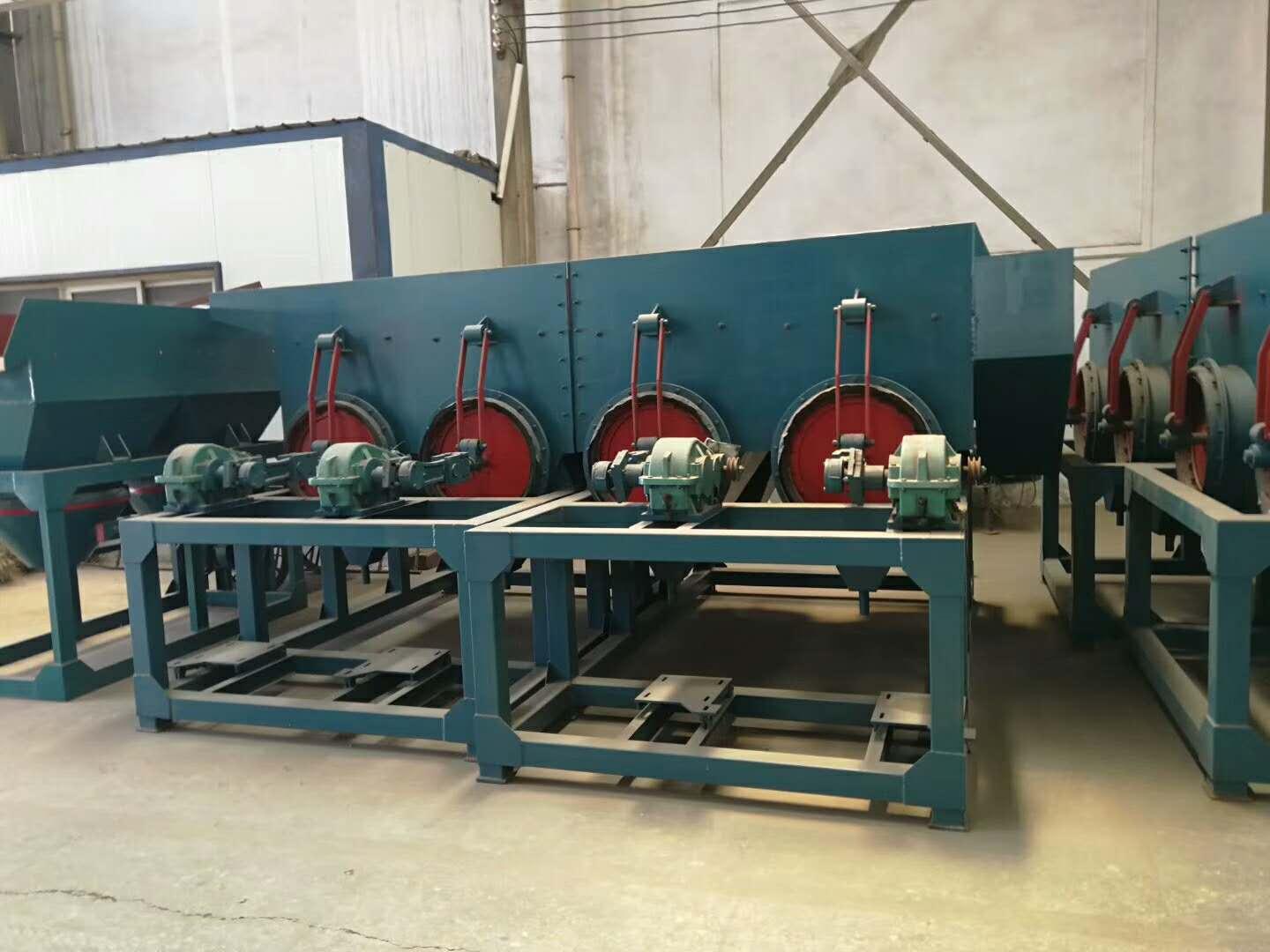
7. Antimony Mining Equipment | Antimony Mining Machinery and Auxiliary Equipment, such as circular vibrating screens, mixing drums, and power supply equipment.
Antimony ore is primarily classified into two types: antimony oxide and antimony sulfide. Regardless of the type of antimony ore, antimony mining equipment and machinery can utilize the following antimony ore beneficiation process: hand separation, gravity separation, and flotation. Because the specific gravity of antimony ore differs significantly from that of the gangue, gravity separation is energy-efficient and environmentally friendly, while also pre-enriching low-grade ore. The antimony ore is then purified to produce antimony concentrate. Therefore, this method is widely applicable to the beneficiation of various antimony ores.
Antimony Mining Equipment | Antimony Mining Mechanical Gravity Separation Line Working Principle: After coarse crushing, the raw antimony ore enters the crusher and reaches the feed size range of the rod mill. It is then fed by a conveyor into the rod mill's hopper. A vibrating feeder below the hopper evenly feeds the crushed material into the rod mill for fine grinding. The finely crushed antimony ore then flows through a chute into the jig for gravity separation and purification. The jig's purified concentrate and tailings are dewatered and transported to the destination, completing the entire antimony gravity separation process. It's important to emphasize that the rod mill is primarily used to prevent over-crushing of antimony ore crystals, which can lead to loss in the gravity separation process. This type of grinding equipment effectively reduces over-crushing and offers significantly higher grinding efficiency than ball mills. It is widely used in the beneficiation of rare metals such as tin, antimony, and tungsten. This antimony gravity separation process and equipment is suitable for the beneficiation and purification of various antimony minerals, including stibnite, stybaurite, antimony chalcanthite, and stybauthite, making it the most practical antimony ore separation process.
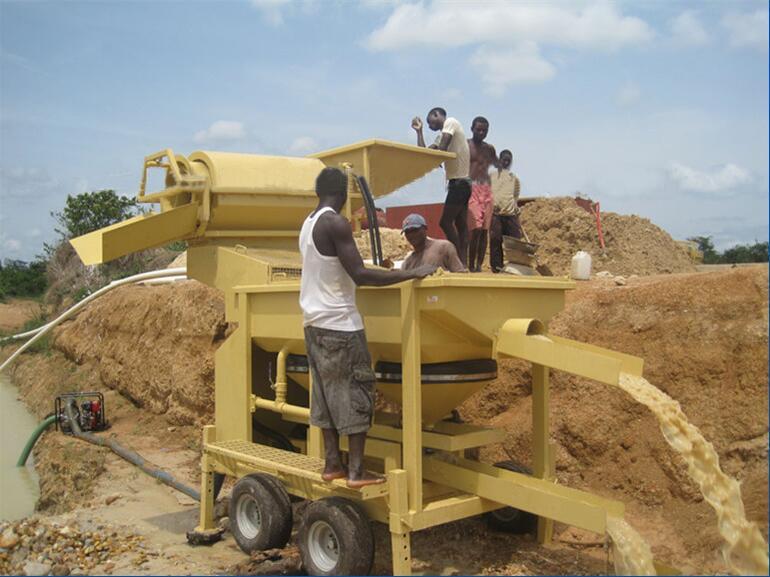
Antimony Mining Equipment | Mechanical gravity separation methods for antimony ore processing feature low equipment investment, low production costs, high beneficiation efficiency, and are environmentally friendly. Gravity separation is applicable to nearly all antimony ores, making it the most widely used and ideal beneficiation method. Antimony ore beneficiation typically utilizes a combination of multiple processes, as single gravity separation or flotation alone cannot achieve the lowest cost and best benefits. Therefore, a combination of multiple beneficiation methods is required, such as gravity separation-flotation, hand separation-gravity separation-flotation, and flotation-gravity separation. These combined processes achieve higher performance for complex antimony ores. Designing beneficiation methods and processes tailored to the specific properties of the ore is crucial for improving antimony ore beneficiation performance.
Antimony Mining Equipment | Mechanical gravity separation of antimony ore is suitable for most antimony ore concentrators because antimony ore is dense and coarse, making it easy to separate from gangue using gravity separation. Among them, stibnite has a density of 4.62 g/cm³, while the density of gangue ranges from 2.6 to 2.65 g/cm³. Its settling ratio is 2.19 to 2.26, making it an easily separable ore. Yellow stibnite has a density of 5.2 g/cm³, red stibnite has a density of 7.5 g/cm³, and stibnite has a settling ratio of 5.57 g/cm³ to gangue of 2.55 to 2.63, 3.93 to 4.06, and 2.76 to 2.86, respectively. These three antimony ores are highly susceptible to density separation. It contains only hydrous antimony calcium, with a density of 3.14 g/cm³ and a sedimentation ratio of only 1.29 to gangue, making it a difficult ore to separate based on density. However, it is not a major component in antimony ore and does not affect its use in gravity separation. In short, both single sulfide antimony ore and mixed sulfide (and oxide) antimony ore offer excellent conditions for gravity separation. Gravity separation is also inexpensive and can separate a large amount of qualified coarse-grained concentrate within a coarse particle size range while discarding a significant amount of gangue. Therefore, gravity separation remains a popular beneficiation method for antimony ore processing today. Even if it cannot directly produce qualified antimony concentrate, it is often used as a pre-selection step in antimony flotation operations. This is especially true given the current difficulties of flotation in processing antimony oxide ores, making gravity separation the primary beneficiation method for antimony oxide ores.
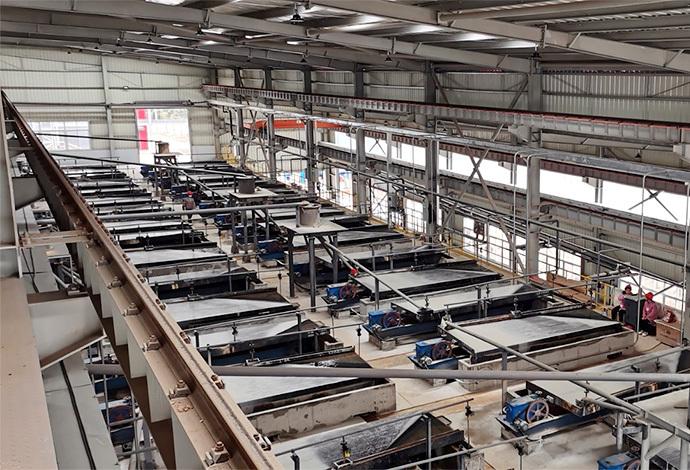
Antimony Mining Equipment | Antimony Mining Machinery Flotation Production Line consists of a jaw crusher, cone crusher, self-centering vibrating screen, ball mill, spiral classifier, hydrocyclone, flotation machine, thickener, filter, and auxiliary equipment such as electric vibrating feeder, belt conveyor, mixing tank, ore bin, sand pump, pump tank, and motor. This complete antimony ore beneficiation production line (antimony ore flotation process) offers the advantages of low energy consumption, high throughput, and economic efficiency.
Antimony Mining Equipment | Antimony Mining Machinery Flotation Antimony Ore Process: First, the vibrating feeder feeds the bulk antimony ore into the jaw crusher for preliminary crushing, and then a closed-circuit grinding process is adopted to evenly feed the material and water in a suitable proportion into the antimony ball mill for grinding. After grinding to a certain fineness, it is classified by the spiral classifier. The unqualified antimony ore powder screened out needs to be sent back to the upper level for re-grinding. The antimony ore powder that meets the requirements is sent to the flotation machine for flotation and impurity removal. At this stage, corresponding reagents need to be added for reasonable sorting, and then the concentrator is used for dehydration to obtain the final antimony concentrate.
The specific process for the combined gravity separation and flotation process for antimony mining equipment and machinery involves coarse and fine crushing of hand-selected raw ore to a particle size below 30mm. The ore is then screened and graded into three fractions: 8-30mm, 2-8mm, and 0-2mm. The ore then enters the AM30 jig, LTA1010/2 jig, and sawtooth jig for gravitational separation. The resulting concentrates are then mixed and fed into the gravity separation area. Following the gravity separation process, the flotation process is followed by grinding, grading, mixing, and flotation of the gravity separation tailings. The flotation process utilizes a one-coarse, three-fine, and two-sweep flotation process. Flotation produces high-grade antimony flotation concentrate. The flotation tailings are then subjected to a shaker gravity separation process to recover fine-grained antimony oxide, resulting in high-grade antimony concentrate and tailings. For lumpy rich ores with particularly coarse embedded particles, a hand separation process is added to the crushing process to manually separate the lumpy rich ores. The hand separation tailings are then crushed and screened again before entering the gravity separation process. The embedded particles of antimony ore in the rock are generally coarse and have a large specific gravity difference with the gangue. Therefore, the antimony ore beneficiation process is generally based on the combined process of gravity separation and flotation to obtain economic indicators and beneficiation indicators.
Main Features of Antimony Mining Equipment and Machinery:
① Antimony Mining Equipment and Machinery for the separation of antimony sulfide ores are primarily conducted under natural pH conditions. The activator is lead nitrate. Collectors include butyl xanthate, butyl xanthate + shale oil + kerosene, butyl xanthate + ethyl thiocyanate + shale oil + kerosene, butyl ammonium black powder, and others. Experiments using isopropyl xanthate as a frother have also been successful. Pine oil is used as a frother, and experiments using carbenoxol oil as a frother have also yielded good results.
② Antimony Mining Equipment and Machinery for the separation of mixed antimony ores utilizes a combined gravity separation and flotation process. Three-stage jigging produces coarse antimony concentrate (including antimony sulfide and antimony oxide). The tailings are ground and classified for flotation, where the antimony sulfide concentrate is floated out. The tailings then enter a shaking table for the separation of fine antimony oxide.
③ Antimony Mining Equipment | Mechanical Separation of Antimony Ore. Most antimony ores are typically mixed and floated, resulting in an antimony-gold concentrate. Laboratory tests for antimony-gold separation have been relatively successful, but production challenges remain.
④ Antimony Mining Equipment | Mechanical Separation of Antimony Ore uses heavy medium separation to pre-discard some waste rock during antimony ore beneficiation, improving the grade of the ore being processed, replacing manual sorting operations and increasing labor productivity. This has proven successful in production practice.
⑤ Antimony Mining Equipment | Mechanical Separation of Antimony Ore. Branch flotation has shown significant results in reducing reagent consumption, removing arsenic, and improving separation performance. The dosage of butyl xanthanum was reduced from 800 g/ton to 320 g/ton, and the arsenic content of the antimony concentrate was reduced from approximately 3% to 0.59%. The antimony concentrate grade and recovery rate reached 59.76% and 92.82%, respectively.
In the design and operation of antimony ore beneficiation plants, the selection of antimony mining equipment and machinery is crucial to maximize the recovery and utilization of useful minerals from the incoming antimony ore, minimize energy consumption, reduce environmental impact and pollution, and enhance the economic and social benefits of the plant. Crushing and grinding processes account for over half of a beneficiation plant's energy and steel consumption. Grinding, in particular, consumes far more energy per unit than crushing, accounting for over 85% of the total ore pulverization process and 30%-60% of the plant's overall energy consumption. Therefore, intensifying crushing operations and reducing grinding feed size, such as adopting new crushing processes and selecting large, efficient crushing equipment, are crucial approaches to improving crushing efficiency and reducing antimony ore beneficiation costs. These principles are fundamental principles that should be followed and considered in beneficiation plant design.
Antimony mining equipment | The selection of antimony mining machinery should not only be based on the physical and chemical properties of antimony ore, antimony mineral composition, antimony mineral structure and embedding characteristics as basic conditions, but also consider factors such as the content of valuable components, the requirements of adapting to antimony metallurgical technology and the ultimate economic benefits.
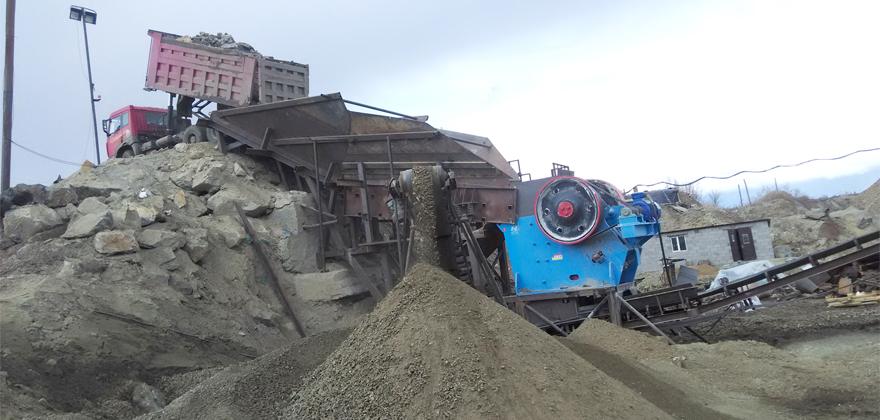
Our company provides turnkey services for our customers' mineral processing plants, including research, design, manufacturing, installation and commissioning, personnel training, after-sales service, and plant management. Our goal is to become a recognized and respected supplier of antimony mining equipment and machinery, both domestically and internationally, and we strive to provide exceptional results at every step. To date, we have developed six major product lines: crushing equipment, grinding equipment, classifying equipment, flotation equipment, gravity separation equipment, and sand making and washing equipment. We implement stringent quality control at every stage of production and delivery, and we are ISO9001:2008 certified. We have been repeatedly recognized as a contract-abiding and trustworthy enterprise, and as an excellent provider of after-sales service. We hold an import and export license for mineral processing equipment, and our products have been sold throughout China and exported to dozens of countries.



